Popular Items in Secondary Combustion Fire Pit


Secondary Combustion Fire Pit


[Secondary Combustion Fire Pits] Explaining the Pros and Cons, and Key Points to Consider When Choosing!
"Secondary combustion fire pits" are popular among those concerned about the smell of campfires.
However, even though they’re popular, it seems there are quite a few people who don’t know the details—such as how they work or what their features are.
In this article, we’ll explain the pros and cons of secondary combustion fire pits and how to choose the best one for you.
If you’re interested in secondary combustion fire pits, please use this as a reference.
What Exactly Is Secondary Combustion?
"Campfires" have grown in popularity in recent years due to the camping boom.
Campfires aren’t just for gazing at for relaxation or staying warm during the cold season; they’re also practical for boiling water to brew coffee or cooking meals.
A fire pit is essential for enjoying such campfires. Recently, many campgrounds have banned open fires for environmental protection, making fire pits a must-have item for camping.
With an endless variety of fire pits available—differing in design, structure, and size—many people own multiple units to suit their camping goals and group size.
And the "secondary combustion fire pit" has been gaining a reputation among many fire pit enthusiasts.
"Secondary combustion" refers to the process of heating the smoke produced by burning fuel and causing it to burn again.
In a typical campfire, burning firewood at high temperatures produces combustible gases, and these gases burn, causing the flames to rise.
This is called "primary combustion," and the smoke is what remains of the combustible gases produced by the firewood.
Secondary combustion refers to the process where the smoke—which contains residual combustible gases—is ignited again by high-temperature air (oxygen). In other words, by burning even the smoke, the fire’s heat output is further increased.
Secondary combustion fire pits are characterized by holes on the sides and top of the main body.
The design allows high-temperature air to flow through the holes at the top, mixing with the smoke from the primary combustion to fuel the fire.
Benefits of Secondary Combustion Fire Pits
What are the benefits of a secondary combustion fire pit?
Benefit 1: Less Smoke and Less Odor
Many people love bonfires but dislike the heavy smoke that leaves a lingering odor on their hair and clothes.
Secondary combustion fire pits burn the smoke rising from the primary combustion, significantly reducing smoke and making odors less noticeable.
Benefit 2: High Combustion Efficiency and Minimal Ash
Since secondary combustion fire pits combine the flames from the primary combustion with those from the secondary combustion, the fire burns more thoroughly, leaving very little ash behind.
This makes cleanup quick and easy—another major benefit. Any remaining ash can be taken home and used as fertilizer for garden plants or houseplants.
Benefit 3: Enjoy a spectacular bonfire
The combination of primary and secondary combustion flames increases heat output, producing larger flames, so you can enjoy a spectacular bonfire.
Another advantage is that the high heat output allows you to use damp firewood.
Disadvantages of Secondary Combustion Fire Pits
While secondary combustion fire pits offer many benefits, they also have some drawbacks.
Disadvantage 1: Higher Firewood Consumption
While secondary combustion fire pits are appealing for their spectacular flames and high combustion efficiency, they do consume more firewood.
Depending on the size of the fire pit, if you plan to spend the night camping with a fire for a group of 3 to 4 people, you’ll likely need to prepare 2 to 3 bundles of firewood.
If you need to purchase and prepare the firewood, this will add to your expenses.
Additionally, while flames rise from the top of the fire pit, the bottom is enclosed by walls, so despite using a lot of firewood, your feet likely won’t get very warm.
Disadvantage #2: Many fire pits are heavy
Due to their unique design, secondary combustion fire pits tend to be heavier than standard, simple fire pits.
If you’re trying to keep your load as light as possible—such as for solo hiking, camping, or touring—they may not be suitable depending on their weight.
They are best suited for car camping trips where you want to enjoy the flames of a campfire.
Disadvantage 3: Not ideal for cooking
While secondary combustion fire pits let you enjoy a spectacular fire without worrying about smoke, they consume a lot of firewood, so you have to keep adding more wood, which can be a hassle.
Therefore, it may not be the best choice for those who want to enjoy cooking. Cooking over a campfire involves tasks like chopping ingredients and preparing plates while monitoring the heat, which can be quite hectic.
It’s best suited for those who simply want to enjoy watching the fire.
Points to Consider When Choosing a Secondary Combustion Fire Pit
When choosing a fire pit, don’t base your decision solely on atmosphere or appearance; consider various factors and your purpose (whether for viewing or cooking) to select the right type.
The same applies to secondary combustion fire pits; after weighing the pros and cons, choose one while keeping the following points in mind.
Point 1: Choose a size appropriate for the number of users
When deciding on the size of a secondary combustion fire pit, consider how many people will be gathered around the fire (or how many people will be going camping).
Secondary combustion fire pits are heavier than simple foldable models, so keep in mind that larger sizes will also be heavier.
Point 2: There are two main types of materials
Secondary combustion fire pits are broadly categorized into “stainless steel” and “titanium” models, each with distinct characteristics.
-Stainless Steel
Stainless steel is a material commonly used in standard fire pits. It is durable, rust-resistant, and easy to maintain, making it simple to handle.
Another advantage is that it is relatively affordable, making it an accessible purchase. However, keep in mind that it tends to be heavier compared to titanium.
-Titanium
Titanium is more durable than stainless steel and is highly resistant to rust. Furthermore, since it is lighter than stainless steel, it is the ideal material for secondary combustion fire pits, which tend to be heavier than standard fire pits.
However, the high cost of titanium is a drawback. It is not suitable for those who prioritize affordability.
Tip #3: Choose a model that’s easy to assemble
Most secondary combustion fire pits are cylindrical, making them difficult to carry. However, there are also rectangular, modular types available.
While the modular types are compact and easy to carry, they can be a bit of a hassle if they require screws or assembling parts, making the setup process time-consuming.
While this can be fun when you first buy it, after using it a few times, it can become a hassle, and you might end up regretting it, thinking, “I wish I’d gone with something simpler.”
If the design is simple, easy to assemble, and easy to take apart and pack up, you can start a fire as soon as you arrive at the campsite.
Point 4: A trivet is handy if you want to cook
Secondary combustion fire pits aren’t ideal for cooking, but if you’re going to the trouble of having a campfire, you’ll probably want to boil water or make some simple meals.
If you choose a product that comes with a trivet or grill grate, you can place a kettle or pot on it and enjoy cooking over an open flame.
However, while they’re fine for dishes that require high heat, they’re not ideal for dishes that need to be cooked slowly over a steady flame.
Point 5: A design you love is what matters most!
While secondary combustion fire pits are generally cylindrical, there are also rectangular and polygonal models available.
Unlike fire pits used for cooking or heating, these are designed for a style of fire-gazing where you admire the dramatic, flickering dance of flames rising from the top.
Since you’ll be gazing at the fire pit along with the flames, choosing a design you love is definitely the best approach!
It’s a good idea to first make a list of fire pits with shapes you like—the ones that make you think, “This is great!”—and then narrow down your choices by comparing size, weight, and features.
TOKYO CRAFTS’ Secondary Combustion Fire Pit “Blaze Box”
"TOKYO CRAFTS" is a brand that develops original Japanese camping gear, focusing on high usability, functional beauty, and exceptional design.
The brand offers the “Blaze Box,” a secondary combustion fire pit renowned for being easy to enjoy!
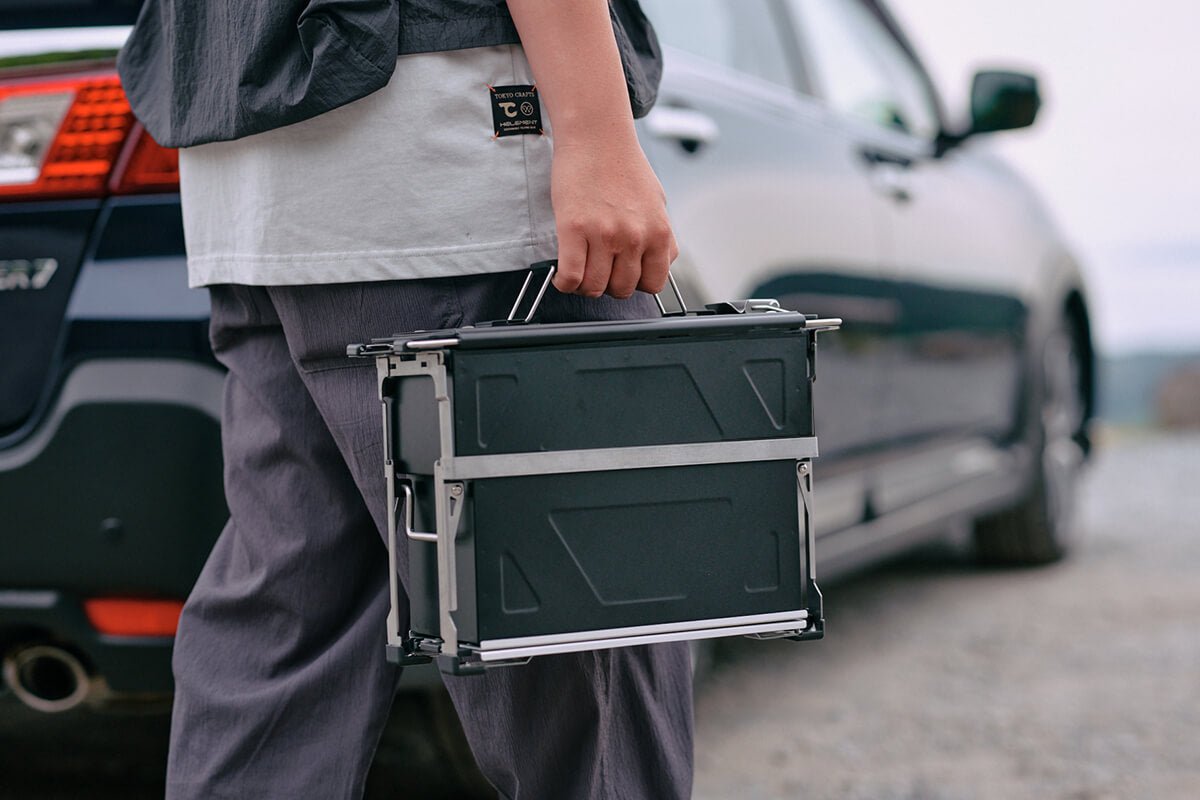
It addresses the common issues of complex structures and bulkiness found in secondary combustion fire pits, offering a simple design that’s easy to transport.
Its appeal lies in its long, horizontal, gently angled hexagonal shape, which allows you to burn standard 30–40 cm logs as-is—no need to cut the wood!
The Blaze Box itself consists of five interlocking parts that assemble easily, making setup a breeze. When packing it away, the main unit and all parts can be flattened and stacked, allowing for a compact storage solution.
The dedicated trivet is spacious enough to hold pots and pans, yet one side remains open, allowing you to cook while simultaneously adding firewood. It’s sized to comfortably accommodate 4–5 people.
A fire blanket provides peace of mind
When enjoying a campfire with a secondary-combustion fire pit that produces large flames, a fire pit liner provides peace of mind.
A fire pit liner is an item placed under the fire pit to protect the campground ground from flying embers and scattered wood chips.
Especially during dry seasons, embers can scatter and land on dry grass, so please use a fire mat to prevent accidents.
While rectangular fire mats are the norm, TOKYOCRAFTS’ original fire mat features a distinctive design: it is an octagon created by cutting the corners of an 80×80 cm square, with handles attached to each corner.
By placing firewood on top of the sheet and holding the cords at the four corners, you can carry the firewood like a carry bag. When laid on the ground, you can secure it by lightly pulling the cords and driving in pegs.
The material is a double-layered, flame-resistant black fiberglass (heat-resistant up to 600°C).
Both sides are coated with silicone, which reduces the prickly sensation often associated with fiberglass sheets.
Its modern, all-black design is a major draw, and when paired with the Bride Box, it creates an eye-catching, stylish bonfire space.
The dual-combustion fire pit is recommended for those who want to enjoy a spectacular bonfire!
While "campfire" may sound simple,
- there are different ways to enjoy it:
- or a fire used to slowly simmer a stew
- and bonfires where you watch the flames rise spectacularly
and so on—there are many different styles.
If your goal is simply to “enjoy watching the flames burn slowly,” we highly recommend trying a secondary combustion fire pit. Please also check out our selection of large fire pits.
RANKING
ランキング一覧へ