Popular Items in Camping Sleeping Bag


Camping Sleeping Bag


What is a camping sleeping bag?

A "sleeping bag" is an essential item for overnight camping. It is used as bedding when sleeping at night inside a tent or on a cot.
A single sleeping bag serves as both a mattress and a blanket. Unlike home bedding, it is lightweight, compact, and easy to carry.
Camping sleeping bags (schlafs) come in a wide variety of types and sizes from outdoor gear manufacturers both in Japan and abroad. With so many options available, many people find it difficult to decide which one to choose.
Therefore, we’ll introduce the basics of how to use and choose a camping sleeping bag, as well as other items that are convenient to use alongside it. Please use this as a reference.
Uses for Camping Sleeping Bags

While sleeping bags are generally used for overnight stays during outdoor activities, hiking, and camping, did you know they can also be useful at home or in a car?
① Camping and Overnight Hiking
Sleeping bags are primarily used as a bed during overnight camping and hiking trips. Additionally, the types that can be unfolded are convenient for taking naps, whether laid out inside a tent or on a cot.
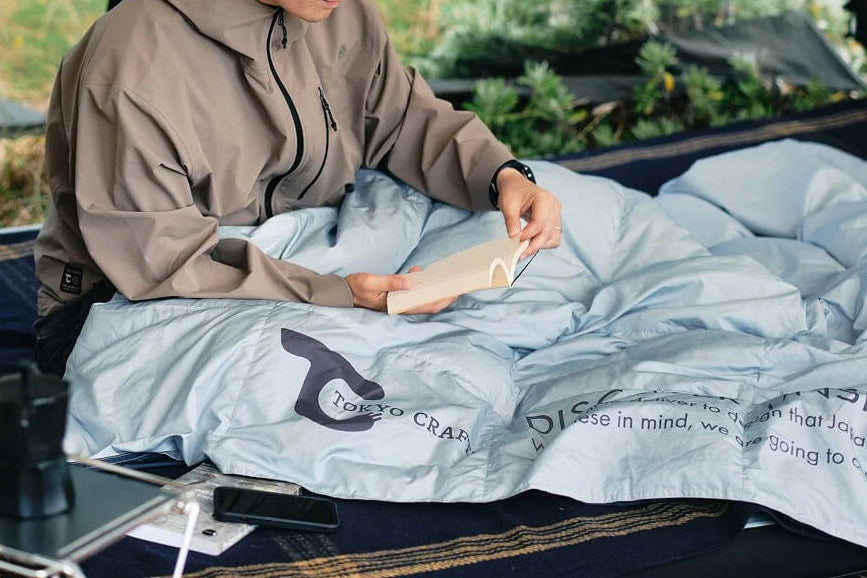
When it’s cold, you can tuck just your lower body into the sleeping bag while sitting in a chair to use it as a lap blanket.
② Handy for Sleeping in Your Car
Sleeping in your car allows you to enjoy the outdoors more casually than camping with a tent. A sleeping bag is particularly handy for this.
They are lightweight and compact, making them easy to carry, and when folded, they take up less space than a regular futon.
③ Can also serve as a guest futon
Sleeping bags can also be used at home. Even if you want to prepare a full set of bedding for guests, it’s often the case that your closet is already full of your family’s belongings and there’s no room left!
Since sleeping bags fold down small, you can store them in even the tiniest of spaces.
④ They’re also useful as disaster preparedness supplies
In Japan, where earthquakes and other disasters are common, it’s essential to prepare disaster preparedness supplies in case of an emergency. If you end up living in an evacuation shelter, having a sleeping bag will be more comfortable than sleeping directly on the floor.
It’s reassuring to keep it folded up and stored alongside your other disaster preparedness supplies.
How to Choose a Camping Sleeping Bag

With so many types of sleeping bags available, it’s easy to feel overwhelmed when you’re ready to buy one.
Here are five key points to consider before making a purchase.
Tip 1: First, Check the Types
The first thing you should know is what types of sleeping bags are available on the market.
Basically, there are envelope-style, mummy-style, and egg-style sleeping bags. Additionally, having an inner sleeping bag—which you can place inside your main sleeping bag to enhance warmth—is convenient during colder seasons.
-Rectangular
As the name suggests, an envelope-style sleeping bag is a “rectangular bag” with the same width from top to bottom, much like a paper envelope.
It has a zipper on the side so you can open it up, and when it gets hot, you can open the foot end to regulate the temperature.
One advantage is that it doesn’t hug your body tightly, so you can roll over just like in a regular futon; however, because there is more space inside, it offers less insulation.
You can also connect two of the same models to create a double size, and if you fully unzip them, they transform into a wide comforter or mattress pad.
It’s recommended for camping beginners and families with young children.
-Mummy-style
A mummy-style sleeping bag is designed to follow the silhouette of your entire body, much like an Egyptian mummy.
Because it fits snugly against the body, there is no wasted space, and it retains body heat, making it highly effective at keeping you warm. It is perfect for winter camping in cold temperatures or mountaineering at high altitudes.
It’s lighter and folds more compactly than an envelope-style sleeping bag, making it highly portable.
However, because it fits so snugly, you may find it difficult to turn over or move around, so you might not be able to sleep in it until you get used to it.
-Egg-shaped
The egg-shaped sleeping bag has a smooth, rounded form. It can be described as a hybrid that combines the best features of envelope-style and mummy-style sleeping bags.
The head and foot sections are rounded to improve insulation. The torso section is spacious and roomy, ensuring a comfortable night’s sleep.
Like the mummy-style, it packs down compactly, making it well-suited for solo camping or touring.
-Inner Sleeping Bag
An inner sleeping bag is a piece of bedding designed to be used inside your main sleeping bag. It is said to raise the temperature inside the sleeping bag by about 5°C, allowing you to sleep soundly even during cold winter camping trips.
Additionally, during the hot summer months, you can sleep using just the inner sleeping bag.
It is moisture-wicking, absorbing sweat produced while sleeping, which also helps prevent your sleeping bag from getting dirty.
How to Choose #2: Select a Size That Fits Your Body Type
You need to choose a sleeping bag that fits your height and body type. Here’s a breakdown of recommended sizes by type.
[Mummy-Style]
Since there is a "recommended height" specification, choose a size that is about 5–15 cm larger than your own height. However, if it is too large, excess space will form, reducing its insulation.
- Long: Up to 195 cm (larger men)
- Regular: Up to 180 cm (average-sized men)
- Short: Up to 165 cm (petite individuals, women)
【Envelope Style】
Envelope-style sleeping bags are labeled as "Single" or "Double." Generally, the single size should be sufficient. If you have two of the same model from the same manufacturer, you can connect them to create a double size.
- Single: Fits about one adult
- Double: Approximately 2 adults or 1 child
How to Choose #3: There Are Mainly Two Types of Filling Materials
There are two main types of filling material for sleeping bags: synthetic fibers and down (feathers).
-Synthetic Fibers
The appeal of synthetic fibers is that they offer high durability and insulation at a reasonable price. They are perfect for camping beginners or family camping trips when you need to purchase enough for everyone. There are three types of synthetic fibers.
[Hollow Fiber]
Also known as “hollow fibers,” these synthetic fibers have a hollow interior, similar to macaroni. Because they are hollow, they offer the benefits of being lightweight and quick-drying.
【Microfiber】
These are ultra-fine fibers less than one-hundredth the thickness of a human hair. Characterized by higher thermal insulation and moisture-wicking properties than hollow fiber, they are soft, lightweight, and compact.
【Ultra-Fine Fiber】
This fiber features a multi-layer structure, making it highly durable. It also dries quickly, so the sleeping bag can withstand repeated machine washing. This helps keep it clean.
-Down
Down is made from the feathers of waterfowl. It expands significantly to create a layer of air, providing excellent insulation. It is also lightweight and compact, making it easy to store and carry.
However, compared to synthetic fibers, it has the disadvantages of being vulnerable to moisture, requiring more maintenance, and being more expensive. Since it is difficult to wash at home, it must be sent to a professional cleaner.
Down quality is indicated by "FP (Fill Power)." FP is a numerical value representing the down's resilience and ability to regain its original volume.
A higher number means that "a smaller amount of down can trap more air," resulting in a lighter, more compact sleeping bag with superior insulation.
Generally, down with a fill power of 600–700 is considered good quality, while down with a fill power of 700 or higher is considered high quality.
How to Choose #3: The "Recommended Temperature Range" Varies Depending on the Season You're Camping In
Sleeping bags list a recommended temperature range (which varies by manufacturer and may be labeled as “operating temperature,” “comfort temperature,” or similar terms).
As a general rule of thumb, you should consider the temperature listed on the product plus about 5°C. For example, if the recommended temperature is listed as 10°C, the sleeping bag is suitable for use in seasons (such as spring from March to April and fall from October to November) and locations where the temperature is around 15°C.
In addition to the recommended temperature, you may also see terms like "limit temperature" or "minimum temperature" listed. Please consider these as guidelines indicating that you should avoid using the sleeping bag if the temperature exceeds or falls below these values. Please also refer to our article on winter sleeping bags.
Tip 4: A compact design makes it easier to carry
If you plan to carry your sleeping bag while camping or hiking, we recommend choosing one that packs down as compactly as possible.
The criteria for a compact sleeping bag are...
- Mummy-style over envelope-style
- A good guideline for packed size is approximately 30 cm in height and 15 cm in width (about the size of a 2-liter plastic bottle)
- Down filling is lighter and packs down smaller
While sleeping bags generally come with a stuff sack, using a "compression bag" that compresses the sleeping bag further allows you to pack it even more compactly.
Items to use with camping sleeping bags
To make your sleeping bag more comfortable, a "mat" and a "cot" are useful.
Mat

A "mat" is essential for a more comfortable night's sleep. Placing a mat between your tent and sleeping bag absorbs the unevenness of the ground, preventing back and hip pain, and blocks heat and cold from the ground.
There are foam mats that are ready to use as soon as you unfold them, inflatable mats that automatically draw in air and inflate when you open the valve, and air mattresses that you inflate using an electric pump or by hand.
Cot

A cot is a simple, bench-style bed. Setup is easy—just unfold the legs. Placing your sleeping bag on top of the cot keeps you off the ground, preventing discomfort from unevenness as well as heat and cold from the ground.
In the summer, using a cot with a mesh seat allows heat trapped between the sleeping bag and the cot to escape, while letting in a breeze from outside, ensuring a comfortable night’s sleep.
Pillow

Using a camping pillow with your sleeping bag allows you to sleep comfortably without straining your shoulders, neck, or head.
- "Self-inflating type" that you inflate manually
- "Inflatable type" that inflates automatically
- "Foam type"—ready to use right out of the package
- "Stuff sack type," which is bag-shaped and used by stuffing clothes or towels inside
Choose the one that feels most comfortable for you.
"NANGA × TOKYO CRAFTS" Custom Sleeping Bag

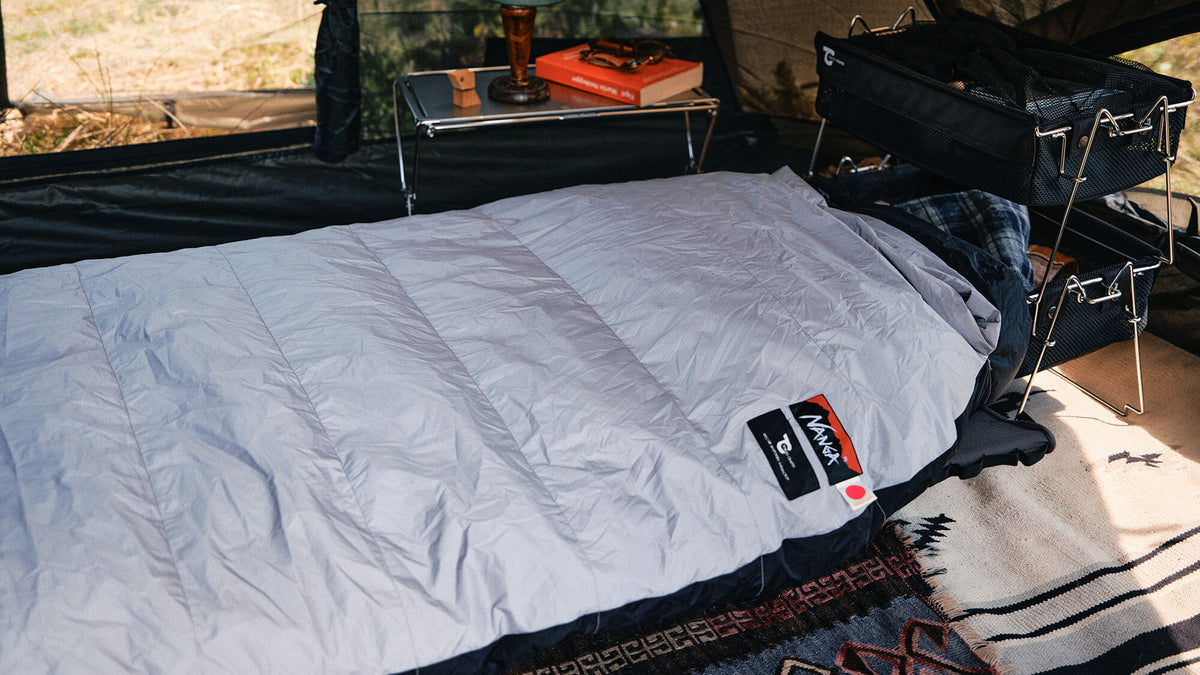
The "Aurora Tex Square Foot 750" was created through a collaboration between "NANGA," a sleeping bag manufacturer renowned for its trustworthiness and track record, and "TOKYO CRAFTS."
This high-spec, limited-edition model combines the best features of mummy-style and envelope-style sleeping bags.
The outer fabric uses NANGA’s proprietary “Aurora Tex®” material, which boasts high durability. Additionally, the down filling uses “Recycled Down,” an eco-friendly material.
It is rated for temperatures ranging from -6°C to -14°C, with a fill power of 700 FP, delivering excellent thermal insulation. This versatile sleeping bag can be used as a blanket when fully unzipped, or connected to another unit to create a two-person sleeping bag.
Sleeping Bag Pillow

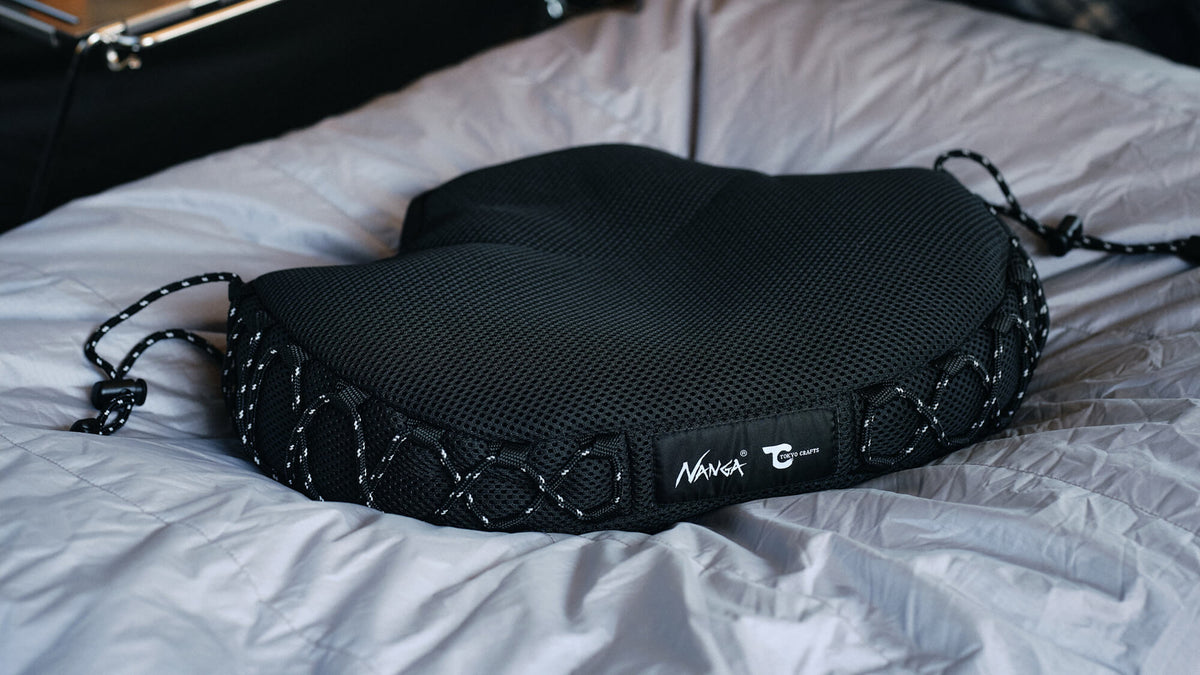
The "Sleeping Bag Pillow" enhances comfort when used with the sleeping bag.
Developed as a custom order by the trusted down manufacturer "NANGA" and TOKYO CRAFTS, this camping pillow is designed exclusively for NANGA sleeping bags. Its shape fits perfectly into the hood of the sleeping bag, making it highly resistant to shifting while you sleep.
The drawcords on the sides allow you to easily adjust the height and firmness, so you can customize it to your preferred sleeping comfort. The internal filling uses polyethylene tubes, and you can adjust the amount through the zipper on the back.
The included mesh storage bag is breathable and convenient for transport. This gear is recommended for campers who want to improve the quality of their rest while outdoors.
Choose the camping sleeping bag that’s right for you!
The most important thing when camping is "how comfortably you can sleep at night."
Don’t choose a camping sleeping bag based solely on price or appearance; be sure to compare options while keeping the points mentioned here in mind.
Be sure to read this article and choose the product that’s perfect for you.
RANKING
ランキング一覧へ